
Invasive Plants of Distant Hill
“Two things are infinite: the universe and human stupidity; and I'm not sure about the universe.” Albert Einstein
Go to our Invasive Plant Resource Page for more info on removal
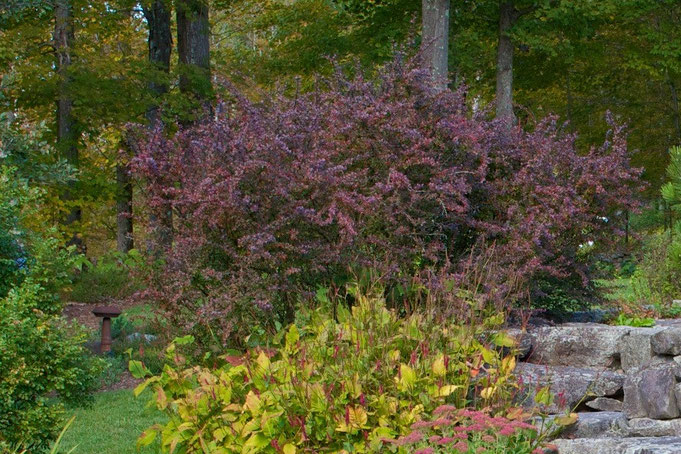
Many of the plants in the list below have been found growing in the forests and fields of Distant Hill. A few of the plants were planted by us before they were known to be invasive. We are removing them from the property as quickly as we can. Live and learn!
Scientific Name
Common Name
Alnus glutinosa
Berberis thunbergii
Celastrus orbiculatus
Elaeagnus umbellate
Euonymus alatus
Euonymus fortunei
Iris pseudacorus
Lonicera japonica
Lythrum salicaria
Phellodendron amurense
Rhamnus carthartica
Rhamnus frangula
Robinia pseudoacacia
Rosa multiflora
European Black Alder
Japanese Barberry
Asian (Oriental) Bittersweet
Autumn Olive
Burning Bush
Winter Creeper
Water-flag or Yellow-flag Iris
Japanese Honeysuckle
Purple Loosestrife
Amur Cork Tree
Common Buckthorn
Glossy Buckthorn
Black Locust
Multiflora Rose
NRCS Invasive Plant Control Funding
In 2013, we received a grant from the USDA Natural Resource Conservation Service (NRCS) to remove invasive plants from our property. That spring and summer we mechanically removed hundreds of common and glossy buckthorn, autumn olive, oriental bittersweet, Japanese honeysuckle, and multiflora rose with a tractor and winch.
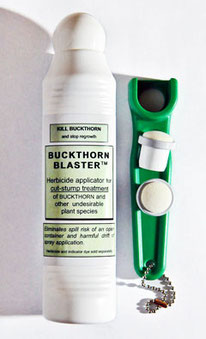
In the fall of 2014, we followed up the mechanical control of the previous year with chemical control, applying Roundup with two different applicators:
- With a hand-held sprayer
- And with a Buckthorn Blaster.
The Buckthorn Blaster™ is an inexpensive hand-held, 4-ounce capacity herbicide applicator for cut-stump herbicide treatment of buckthorn and other undesirable stemmed plants. The replaceable foam applicator tip of the Buckthorn Blaster™ releases herbicide only when pressure is applied to freshly cut stumps. It uses a tiny amount of herbicide compared to spraying, allowing us to spend hours treating stumps without a refill. And it eliminates the "drift" hazard to humans and native plants associated with herbicide sprayers.
HIGHLY RECOMMENDED!
Note: You can save some $$ and purchase a bingo dauber instead. It works just as well.
The New Hampshire Guide to Upland Invasive Species is a great resource to help identify the invasive plants and insects of New England.
Go to our Invasive Plant Resource Page for more info on removal.
This can also be accessed through "Workshop Resources" in the menu.
Please Support Our Generous Sponsors







Distant Hill was listed as one of the Top 10 Places to Visit in New Hampshire!
or send a check via Snail Mail to:
Distant Hill Gardens and Nature Trail, 507 March Hill Road, Walpole, NH 03608
Friends of Distant Hill (dba Distant Hill Gardens and Nature Trail) is a nonprofit,
tax-exempt organization under Section 501(c)(3) of the U.S. Internal Revenue Code.
Donations are tax-deductible as allowed by law. Tax ID# 84-3765898