

Salidago, commonly called Goldenrod, is a genus of over 100 species of flowering perennial plants in the aster family. The majority are native to North America, with just a few species native to South America and Eurasia. The pollen of Goldenrod is often unfairly blamed for causing hay fever in humans. However, the true culprit is the wind-dispersed pollen of Ragweed (Ambrosia sp.), which blooms at the same time as goldenrod. Goldenrod pollen is too heavy to be easily blown about, with the...
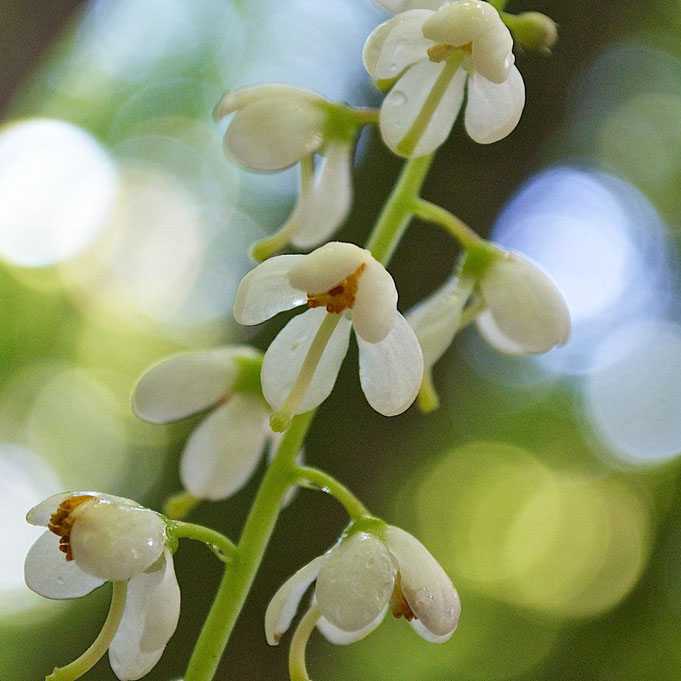
Shinleaf (Pyrola elliptica) is a native perennial wildflower that can be found growing in the woods of Distant Hill Gardens. It is an evergreen herb, 5-10 inches high with a slender, branching rootstock that produces a set of basal, dark green, ovate to elliptical leaves. The naked flower stalk bears from 7-15 white, waxy, drooping, greenish-white flowers, which smell like lily-of-the-valley and bloom in early summer here in southern New Hampshire.
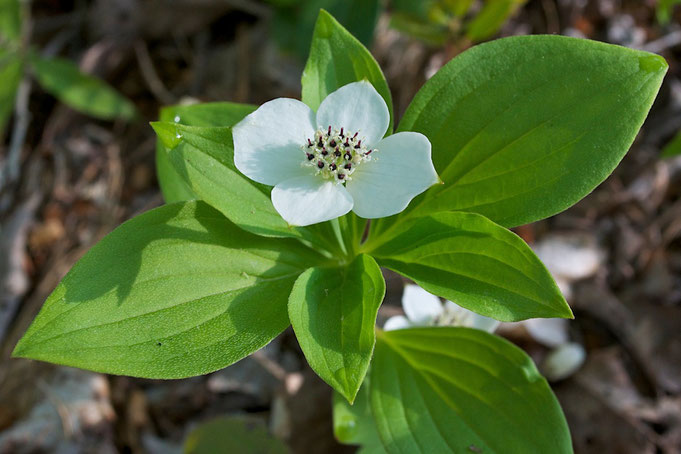
Canadian Bunchberry (Cornus canadensis) is a woodland perennial flowering in late spring at Distant Hill Gardens. It only reaches a height of about 8 in (20 cm), unlike other taller native dogwoods that are shrubs or small trees. It grows in moist partial shade, often under conifers, and in wooded swamps, shaded bogs and peaty areas. It likes acidic soils, which we don't have much of on Distant Hill. Just a few Bunchberries grow on the acidic shore of the Cranberry Bog/fen under some native...

The Bronze Fern, also known as Cut-leaved Grape Fern or the Common Grape Fern, is unusual in that it grows in one of two forms, a broad leaf form (Sceptridium dissectum obliquum, syn. Botrychium dissectum obliquum), or a skeletonized cut-leaf form (Sceptridium dissectum dissectum, syn. Botrychium dissectum dissectum). This small grape fern also has an unusual life cycle. It begins it growth during the late summer, when new leaves (both fertile and infertile) are produced.
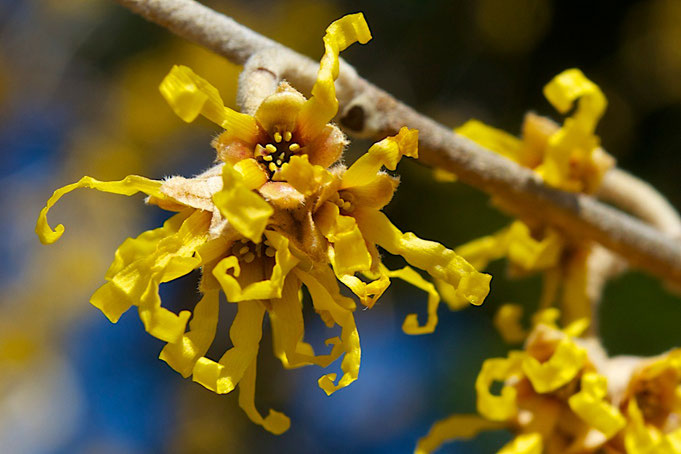
Witch-hazel (Hamamelis) is a genus of flowering plants in the family Hamamelidaceae, with three species in North America and one each in Japan and China. They are deciduous shrubs or small trees growing to 10–30ft (3–9m) tall.
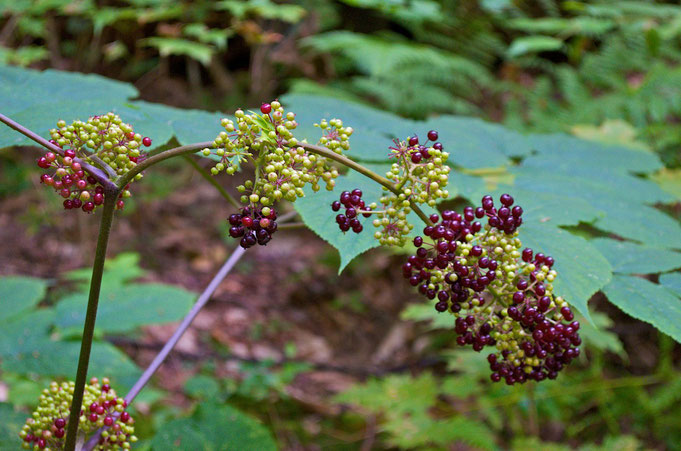
American spikenard (Aralia racemosa) is one of my favorite shade-loving native plants under cultivation at Distant Hill Gardens. American spikenard is a relative of ginseng. A perennial here at Distant Hill Gardens, it reaches up to 6 feet in height and makes a striking display in the garden. The plant produces tiny greenish-white flowers in rounded clusters in the summer and dark purple-red berries in the fall. One of its most beautiful attributes of Aralia racemosa are its heart-shaped leaves...
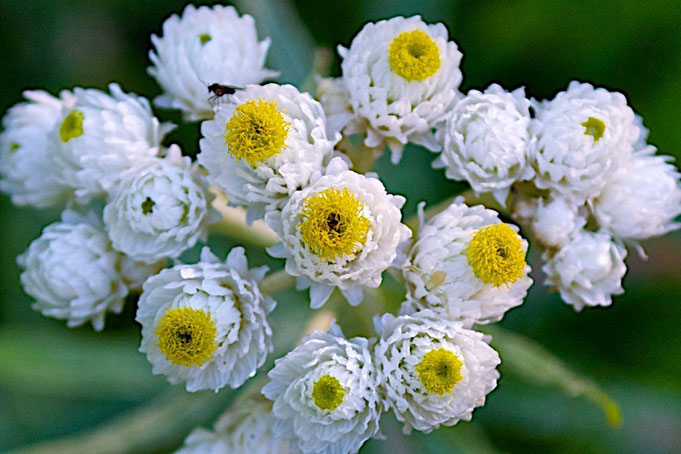
Western Pearly Everlasting (Anaphalis margaritacea), also known as simply Pearly Everlasting, is a perennial wildflower that was often used medicinally by North American Indian tribes to treat a range of ailments. Common uses for this species included poultices for treatment of sores, boiling in tea or a steam bath for rheumatism, or smoked to treat colds. The plant was also among many native species of plant used as a tobacco substitute.
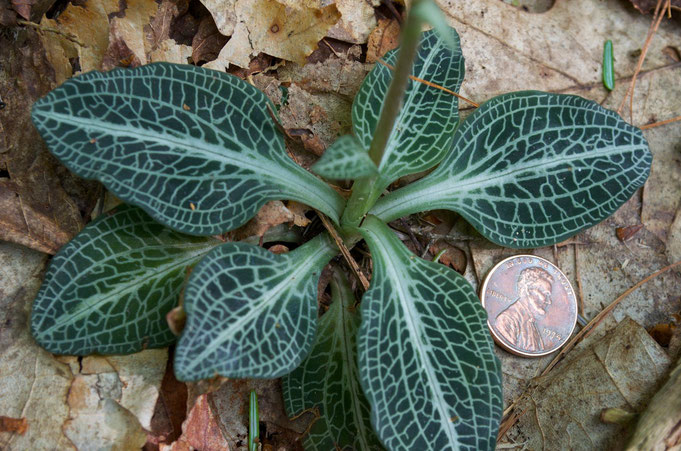
Downy rattlesnake-plantain (Goodyera pubescens) is one of three species of the genus Goodyera native to Distant Hill Gardens. It is the most common species of rattlesnake-plantain in New England, and can be easily identified by the broad central stripe down the middle of each leaf. The evergreen foliage is attractive year round, with individual leaves lasting 3 to 4 years. It flowers in late summer with small white flowers densely packed on a slender cylindrical spike, 6 to 18 inches tall....

Ants are shown here feeding on the nectar and possibly pollinating flowers of Spreading dogbane (Apocynum androsaemifolium). This native bushy perennial grows on the field edges at Distant Hill Gardens. I said "possibly pollinating" because scientists have discovered that many ants secrete a natural substance that acts as an antibiotic. This secretion protects ants from bacterial and fungal infections, but unfortunately this secretion also kills pollen grains rather quickly.
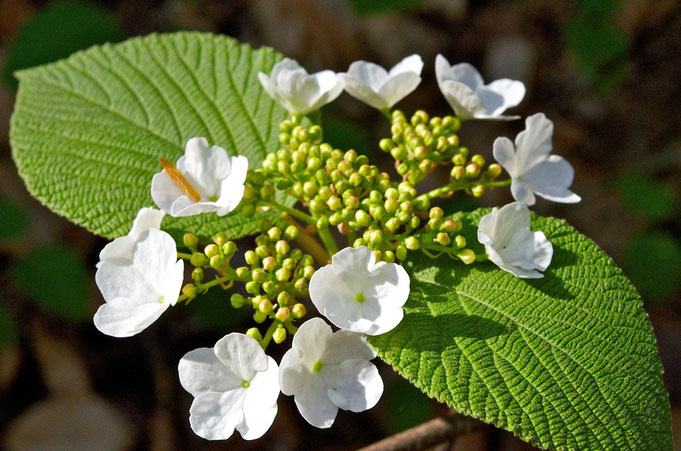
Hobblebush (Viburnum alnifolium - syn. lantanoides) blooms in early May in the woods of Distant Hill Gardens. It is a shade loving deciduous shrub growing 6–12 ft (2–4 meters) high, with branches that will root if they touch the ground. These rooted branches form obstacles which can trip (or hobble) walkers – hence the common name.
Please Support Our Generous Sponsors








Distant Hill was listed as one of the Top 10 Places to Visit in New Hampshire!
or send a check via Snail Mail to:
Distant Hill Gardens and Nature Trail, 507 March Hill Road, Walpole, NH 03608
Friends of Distant Hill (dba Distant Hill Gardens and Nature Trail) is a nonprofit,
tax-exempt organization under Section 501(c)(3) of the U.S. Internal Revenue Code.
Donations are tax-deductible as allowed by law. Tax ID# 84-3765898